|
The Haitian government is
continuing its push to turn Ile à Vache (Cow Island), off
Haiti’s southern coast, into a major tourist development. The
island’s 15,000 residents, however, are resisting the move,
saying they were not consulted, are not included, and are being
uprooted.
This week,
Haïti Liberté interviewed Kénold Alexis, a
leading member of the Organization of Ile à Vache Peasants (Konbit
Peyizan Ilavach or KOPI). He explains why and how the people of
Ile à Vache, under KOPI’s leadership, are resisting the Haitian
government’s tourist development on the island, and how
heavily-armed police are terrorizing the island’s residents
while Haitian government officials mistreat them .
Haïti Liberté: Earlier
this month, Haiti’s Tourism Minister Stephanie Balmir
Villedrouin said that the Haitian government has not and would
not expropriate peasants on Ile à Vache and that those affected
would be compensated for any losses. What is your response?
Kénold Alexis: I have to say that
the minister is lying. Since the beginning of the project, the
Tourism Minister has been lying to us. The project landed on Ile
à Vache with the minister. We had only heard talk of the
project. They never came beforehand to sit down with the
island’s people to tell us what the project entails.
It was when they began to
intrude on the peasants’ lands with surveyors and tractors,
bulldozing the peasants’ coconut trees, mango trees, and all the
fruits they had planted on the island, that was when the
peasants began to put their foot down, to demonstrate, to demand
explanations about the project. But they never came to sit down
with the island’s people to listen to them or to tell them how
the project would be undertaken.
HL: So when the government
now says that nothing will be done arbitrarily, you don’t buy
that?
KA: No, they have been lying to us
from the start. Look how this started. They published a decree
in the official journal Le Moniteur of May 10, 2013 where
they declared Ile à Vache a “zone reserved for touristic
development.” They declared the whole island “for public
utility.” The peasants were automatically dispossessed by
this decree.
HL: What currently is the
police presence on the island? KOPI called on the government to
withdraw the Haitian National Police’s Motorized Intervention
Brigade (BIM) from the island. Has there been any sign that they
will comply?
KA: After our big Dec. 27, 2013
demonstration with which we demanded an explanation about the
project, the Tourism Minister came to sit down with us
empty-handed, trying to give us a verbal explanation of the
project. We in KOPI asked her to go find the documentation for
the project and bring it to us. A huge project like this cannot
be presented to us without our reviewing the relevant paperwork.
She left and made a second trip
to bring us the documentation. We asked her to give us about
two months for us to read and analyze the documents to see what
was good in the project. At that point they said we would have a
truce, and all the activity on the island would be stopped. They
would not do anything until we called them to tell them how we
see the project.
Well, they violated that
agreement and our rights. They came and started work on an
airport. They began digging in [the township of] Madame Bernard
without respecting us.
We therefore had to make a
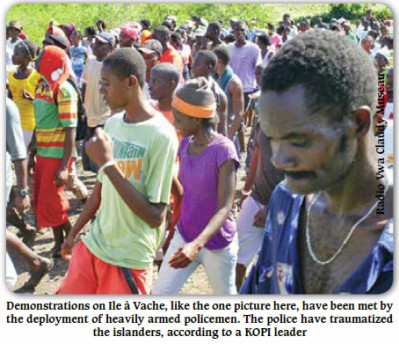
third demonstration on Feb. 7, 2014. After that demonstration,
the government’s local interim agent, Fritz César – who wasn’t
even in Haiti, he was in the United States – came and learned
that we had organized a demonstration on Feb. 7. He went on the
radio an said that we entered, carried out reprisals, and burned
things at two hotels [Port Morgan and Abaka Bay Resort] which
are in an area called Kay Kòk.
But there was never anything
like that. Our demonstration was peaceful, without violence. But
on Feb. 8, the government deployed more than 100 BIM agents with
assault weapons. Since then, many young men who were in the
movement have gone into hiding. They spend their days in the
streets, and when the sun goes down, they go home. Up until
today as I speak to you, BIM agents are sowing terror day and
night, creating great anxiety and fear in the population. They
beat people, mistreat people. There are some women who were
pregnant, but due to the emotion caused by the BIM, they have
begun to bleed, and the bleeding hasn’t stopped. For some other
residents, they hear a loud noise and they pee on themselves
because they are constantly scared, never having seen men with
such big guns.
 HL: What is the situation
of Jean Maltunès Lamy, who was arrested on Feb. 21? Have the
authorities responded at all to the demand of Ile à Vache
residents that he be freed?
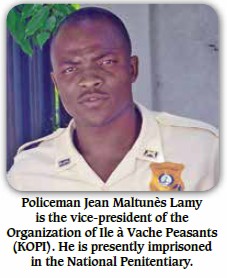
KA: Jean Maltunès Lamy is a
policeman, but he is also the vice-president of the Organization
of Ile à Vache Peasants [KOPI]. He was stationed in
Port-au-Prince, and they arrested him there most likely due to
his position against this project.
As soon as they arrested our
comrade Maltunès, the people again took to the streets to demand
his liberation, the rescinding of the decree dispossessing
peasants of their land, and the withdrawal of the BIM agents
from the island, because they have done many wrongs to the
peasants here.
HL: Mr. Maltunès Lamy is
still being held in the National Penitentiary. Have you any news
of how he is doing there, of how he is holding up?
KA: Yes, we get some news of him
from his wife who goes to see him in the prison. But we in KOPI
have no direct contact with him, and of course in prison he has
no phone. But his wife gives us information about him.
He is in a bad state, not well
at all. Yesterday we had a meeting with an organization which
says it is acting as an intermediary between the government and
us in KOPI and the peasants on the island. Well, Maltunès’ wife
came to that meeting and it was with tears in her eyes that she
told of the bad state he is in. He has children. His father just
had an operation and is due to have a second one. Maltunès
should be taking care of those things, but instead he is in
prison.
HL: What is the next
mobilization foreseen on the island?
KA: Presently, we are standing our
ground. The people are mobilized. We say that if this project is
going to take place on the island, the government will have to
kill us all because we are all completely opposed to this
project. If this were a development project, we are not opposed
to development. We know that development is done with and for
people in the community. But this project involves hotel chains,
agricultural firms, golf courses.
We have 12 beaches on this
island. They took ALL of them, not leaving even one so that
residents could take a little dip in the ocean.
In a development project, there
is the economic aspect and the social aspect. In this project,
which we see they have bundled it up to put on the head of Ile à
Vache’s people, we see the economic, but we don’t see the
social, because we don’t have running water, electricity, roads,
or even latrines. Three-quarters of our people have to do their
business on the ground. We don’t have professional schools. We
don’t have anything at all. All we have is a national public
school right next to where they are making the airport. They say
they are making an international airport. There is a national
school right next to it where the students are sitting on rocks
as the take their classes.
And the international airport
we hear they are making is on the eastern end of the island,
where there was a natural forest where the peasants used to
harvest honey. There was a crab the peasants used to harvest
there, above all in the months of May and June. The peasants
used to make thousands of dollars from that forest. But now,
they have completely destroyed that forest which renders the
population of the zone of Baleraz on Ile à Vache completely
vulnerable. During hurricanes, it was the forest which protected
the residents of Baleraz against the wind and rain.
HL: What kind of
solidarity have you received from other Haitians?
KA: We have received solidarity from
human rights organizations coming from Port-au-Prince. After
Jan. 8, the BIM agents beat up many people with clubs, broke
people’s heads, had them rolling on the ground, stuck guns in
their ears, and kicked them. Many people were traumatized. Human
rights groups like RNDDH [the National Network for Human Rights
Defense] came to question people, as did radios like Radio
Kiskeya and Radio Vwa Claudy Museau from Aux Cayes.
There was a meeting between the
minister with the population. They didn’t want journalists to
come. It was just their journalists that they wanted to be
there. After they came out of that meeting, even though there
was no agreement, no results with us, they said they had reached
a deal with us, everything was going well on the island, even
though nothing was going well at all! They were coming to impose
a development on us by force. We know that development is done
with people and for people in the community, but it is with guns
that they are forcing development down our throats.
This minister who says that
everything is going well, in the first meeting, she said that
they were going to displace people and put them in three places:
Kay Kòk, Madame Bernard and Point Claire. They said in those
three places they would provisionally put people for six months.
We are determined on Ile à
Vache, we are not going to be displaced. We are not going
anywhere, because we were born here, we live here, and this is
where our umbilical cords are buried.
It is true that they came to
take this island from us and put us in some other place. And if
you ever see Ile à Vache, you’ll see that it is a virgin island.
Whatever tourist comes to Ile à Vache, they always say that Ile
à Vache is another country, Ile à Vache is not in Haiti, because
you can walk wherever you want, there is no crime. It is with
the deployment of the BIM agents that insecurity has come to the
island. Previously, people slept where they wanted.
I have a nice house where I am
with a beautiful lawn. When it’s hot, I don’t sleep in the
house. I just take a rug, a sheet, or a reed mat (nat)
and put it on the ground, and then we sleep until the next
morning. We don’t have any insecurity.
But the BIM agents have brought
insecurity. The population has become fearful and traumatized.
There are old folks who have become uncontrollable, they can’t
talk. There are even people who have become sick and are lying
on hospital beds ready to die because of the BIM agents’
pressure on the island.
HL: When journalists from
Haïti Liberté visited last week, they couldn’t find a boat. They
were told that the government had paid boat captains 10,000
gourdes ($225) to not take people to the island. What was that
all about?
KA: There was a delegation of
journalists and human rights people who were coming to the
island. The authorities knew the day the delegation was coming
and managed to find a way to prevent boats from coming to the
island that day. They counted well, but calculated poorly
because we in KOPI have our own boat. We went and got those
people so they could come and question peasants who have been
victims of the BIM.
We take this occasion to let
people know, nationally and internationally, that we on Ile à
Vache are threatened. People sleep with one eye open. You might
go to sleep in your house and wake up to find a BIM agent in
your yard with an assault weapon, asking your name and if you
are a member of KOPI to arrest you. They are trying to stop this
island’s resistance. |





