|
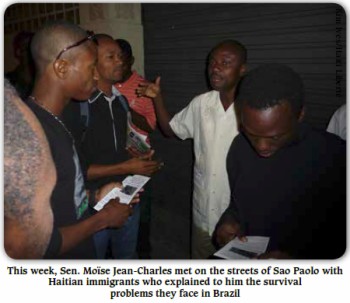 Sen.
Moïse Jean-Charles held several meetings with
disgruntled Haitian immigrants in Sao Paolo this
week as part of a six-day visit to Brazil. On
May 21, he will address both houses of the
Parliament, and on May 22, the Sao Paolo City
Council will recognize him as an honorary
citizen of that city, the Western Hemisphere’s
largest. Sen.
Moïse Jean-Charles held several meetings with
disgruntled Haitian immigrants in Sao Paolo this
week as part of a six-day visit to Brazil. On
May 21, he will address both houses of the
Parliament, and on May 22, the Sao Paolo City
Council will recognize him as an honorary
citizen of that city, the Western Hemisphere’s
largest.
Sen.
Jean-Charles’ current visit to Brazil, like his
two previous ones in 2013, is part of a campaign
to push for the withdrawal of the 9,000-soldier
UN Mission to Stabilize Haiti (MINUSTAH), which
will mark its 10th anniversary on
Jun. 1. Some 2,200 Brazilian troops make up
MINUSTAH’s largest contingent, and Brazilian
generals command the force.
Joining the
senator on his visit to Brazil is Oxygène David,
a leader of the new party Dessalines
Coordination (KOD), which is one of eight groups
in the Haitian Coordination for the Withdrawal
of UN Troops from Haiti. The Haitian
Coordination, whose April declaration Sen.
Jean-Charles also signed, is planning events to
denounce MINUSTAH’s 10th anniversary
in Haiti. There will also be demonstrations
against MINUSTAH in nations around the world
including Brazil, Argentina, Mexico, Peru,
Guadeloupe, St. Lucia, Trinidad-Tobago, Uruguay,
and the United States.
A Haitian
Senate resolution, drafted by Sen. Jean-Charles
one year ago and passed unanimously, called for
all UN troops to be out of Haiti by May 28,
2014. UN authorities have pointedly ignored the
resolution and have fixed no deadline for their
open-ended military occupation to leave Haiti.
 Every Monday
morning, KOD holds a demonstration of about 50
people in front of the UN base at the
Port-au-Prince airport calling for MINUSTAH to
pack up and go. UN troops and Haitian police
have been increasingly disturbed by and
aggressive against the weekly action,
threatening demonstrators with tear-gas and
arrest. Every Monday
morning, KOD holds a demonstration of about 50
people in front of the UN base at the
Port-au-Prince airport calling for MINUSTAH to
pack up and go. UN troops and Haitian police
have been increasingly disturbed by and
aggressive against the weekly action,
threatening demonstrators with tear-gas and
arrest.
On May 18, Sen.
Jean-Charles met with Haitians at the Church of
the Immigrants in downtown Sao Paolo, about a
block from a city-run emergency housing center
which currently holds over 100 Haitian
immigrants. On May 19, Sen. Jean-Charles, along
with Oxygène David and a journalist from
Haïti Liberté, returned to the “Auberge
Emergenciel,” and later to a squatter-run
commercial building, to hear the grievances of
Haitian expatriates.
“I make only
1000 reals (US$450) per month in a terribly hard
job cleaning chemicals from barrels,” said a
27-year-old Haitian man at the housing center
who would identify himself only as Hector. “We
are given dangerous work and don’t make enough
to send home money or even to live. We are
virtually slaves here!”
The Haitians at
the center, managed by the mayor’s office, sleep
in a giant fluorescent-lit hall on metal bunk
beds and use communal bathrooms. The yard has
lots of laundry hanging in it.
There are an
estimated 50,000 Haitians now living in Brazil,
but only 20,000 are legal and have work papers.
Almost all have come to Brazil over the past
decade that Brazilian troops have been in Haiti.
As in many countries, the Haitian immigrants
work in menial jobs as construction workers,
maids, or janitors, although many are trained as
nurses, doctors, accountants, or engineers.
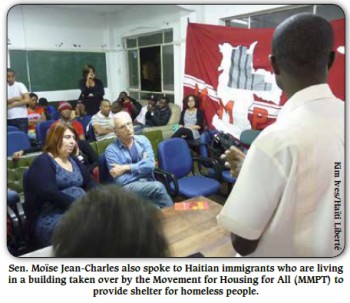
“In talking
with people, we’ve identified three main
problems,” Sen. Jean-Charles said speaking later
on May 19 at the Movement for Housing for All (MMPT),
which has occupied a vacant commercial building
in downtown Sao Paolo to provide shelter for
homeless people, including dozens of Haitians.
“There is the problem of sanitation, of
education, and of salaries. Add to those, there
may have been some human rights violations, for
which Haitians need a lawyer. We are going to
raise all these issues when we meet with local
authorities to see what kind of relief our
Haitian brothers and sisters can receive.”
Meanwhile,
Oxygène David pointed out to the Haitians that
ending the UN occupation of Haiti is in their
interests. “Every year, Brazil spends millions
of reals to support soldiers who are repressing
and killing our brothers and sisters in Haiti,”
he said to Haitians at the housing center. “That
money could be going to hospitals, schools,
agriculture, and better jobs and housing for
immigrants like you here in Brazil. So you have
a double interest in seeing Brazilian soldiers
leave Haiti. One, to end the repression of your
fellow Haitians. Two, to allow more money to be
available for jobs and services here.”
The Brazilian
committee sponsoring Sen. Jean-Charles’s trip to
Brazil, “To Defend Haiti is to Defend
Ourselves,” organized the meetings with Haitian
immigrants as well as the trip to Brasilia to
address both the Brazilian Senate and House of
Deputies on May 21. Sen. Jean-Charles is also
speaking to many radio and television stations
in both Sao Paolo and Brasilia.
On May 22, Sao
Paolo’s City Council will name Sen. Jean-Charles
as a “Citizen of Sao Paolo.” The ceremony, which
will be open to the public, was initiated by
Councilwoman Juliana Cardoso of the ruling
Workers Party (PT) and State Deputy Adriano
Diogo, also of the PT. “It is a very great honor
in Brazil to receive this recognition,” said
Barbara Corrales, the coordinator of the “To
Defend Haiti is to Defend Ourselves” committee.
Last December,
Sen. Jean-Charles visited Brasil to attend the
PT’s National Congress, in which he succeeded in
convincing delegates to pass a resolution
calling for the withdrawal of Brazilian troops
from Haiti. In May 2013, the senator also
visited several Brazilian cities to push for
troop withdrawal.
On Jun. 10,
Sen. Jean-Charles will meet for the second time
with Uruguayan President José Mujica in
Montevideo. “I will ask him to respect the
promise that he made to me during our meeting
last November,” Sen. Jean-Charles told Haïti
Liberté. “He said he was going to withdraw
Uruguayan troops from Haiti. I want to find out
how that is progressing.”
Uruguay has
historically had about 1,100 troops in MINUSTAH,
the second largest contingent after Brazil. |





